MTD for Income Tax Client Records Checklist and Deadline Planner for Accountants (2026/27)
The compliance side of MTD is well covered elsewhere. What is less written about is the operational consequence for a practice: the records-collection workload multiplies by four, on fixed dates, for every affected client at once.
This page is about that. Thresholds and deadlines are taken from GOV.UK with the dates the guidance was last updated; the request cadence is ours and is clearly marked as such.
Short answer
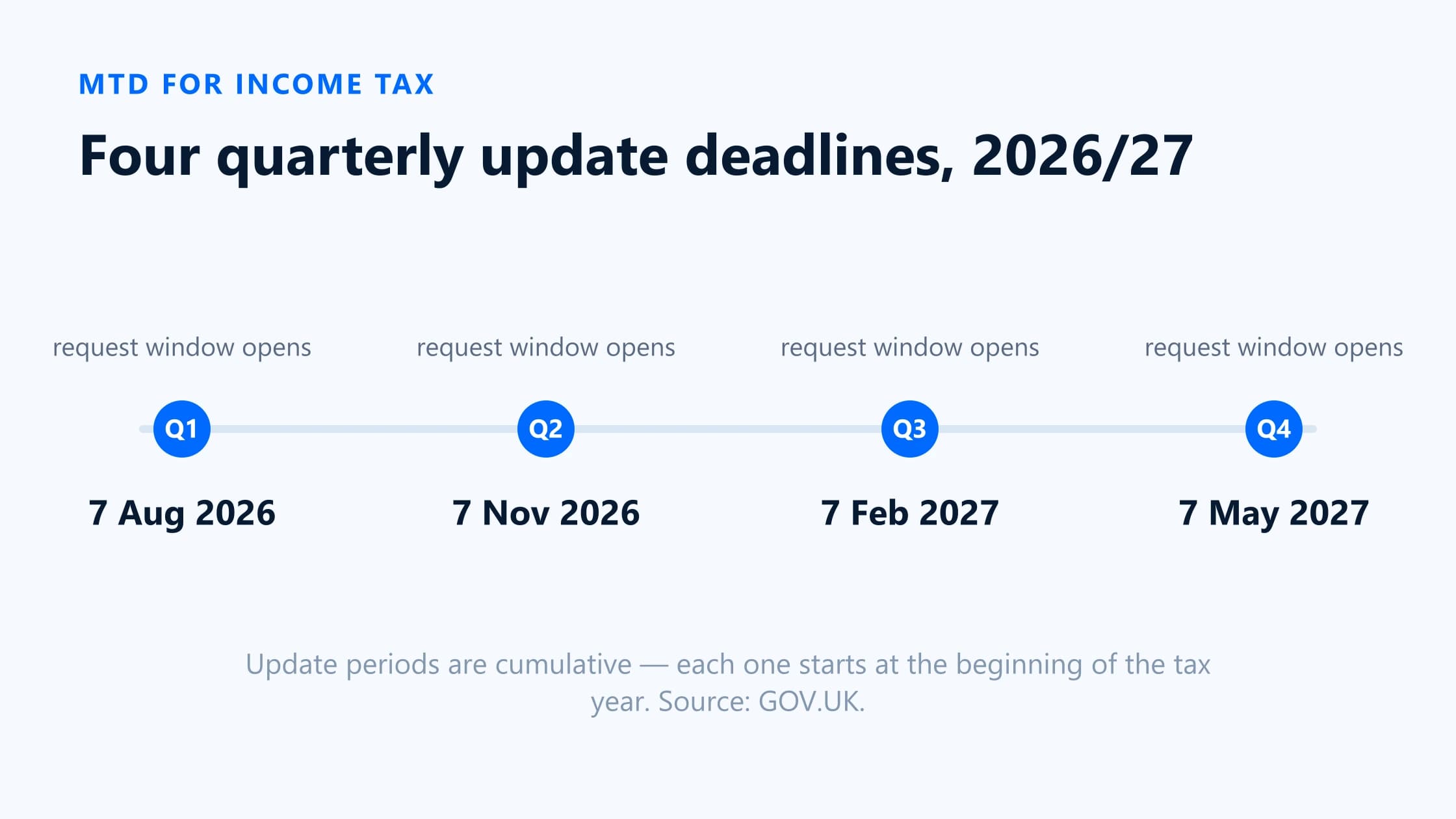
Making Tax Digital for Income Tax replaces one annual records deadline with four quarterly ones. For a client in the first cohort, quarterly updates for 2026/27 are due on 7 August 2026, 7 November 2026, 7 February 2027 and 7 May 2027. The update periods are cumulative — each begins at the start of the tax year rather than at the start of the quarter.
Practically, that means the client records you used to gather once now have to be gathered four times, roughly a month after each period closes. The planner below builds the dates for any of the three rollout years and works backwards to a request cadence. It is a collection planner: it does not file anything and it is not tax advice.
Who this is for
Making Tax Digital for Income Tax applies to sole traders and landlords registered for Self Assessment with income from self-employment or property, where qualifying income exceeds the threshold for the relevant tax year. GOV.UK sets out the rollout as follows.
| Attribute | Qualifying income over | Measured in tax year | Must use MTD from |
|---|---|---|---|
| First cohort | £50,000 | 2024 to 2025 | 6 April 2026 |
| Second cohort | £30,000 | 2025 to 2026 | 6 April 2027 |
| Third cohort | £20,000 | 2026 to 2027 | 6 April 2028 |
First cohort
- Qualifying income over
- £50,000
- Measured in tax year
- 2024 to 2025
- Must use MTD from
- 6 April 2026
Second cohort
- Qualifying income over
- £30,000
- Measured in tax year
- 2025 to 2026
- Must use MTD from
- 6 April 2027
Third cohort
- Qualifying income over
- £20,000
- Measured in tax year
- 2026 to 2027
- Must use MTD from
- 6 April 2028
- HMRC reviews each Self Assessment return and writes to taxpayerswhose qualifying income is above the threshold. GOV.UK is explicit that if no letter arrives, it remains the taxpayer’s responsibility to check.
- A Self Assessment return is still required for the tax year before a client starts using MTD, and quarterly updates do not replace the return.
- Partnerships will be brought in later. GOV.UK says the timeline will be set out at a later date.
- Exemptions exist, including for the digitally excluded. An exempt client still reports through Self Assessment.
Records to request each quarter
The quarterly update is a summary of income and expenses for the period. What you actually need from the client to produce one, quarter after quarter, is the list below. Treat it as a starting template and cut what does not apply — a landlord with two properties and no employees needs perhaps a third of it.
Every quarter, every client
- Bank statements for every business account, covering the full period, including any account opened mid-period.
- Receipts or invoices for card and cash spend that is not already supported in the ledger — this is the pile that never arrives on its own.
- Supplier invoices for anything entered as a bill without a document attached.
- Sales records: invoices raised, till or platform summaries, and anything received outside the main account.
- Explanations for transfers between accounts, drawings and anything paid personally on behalf of the business.
Self-employment, where relevant
- Mileage or vehicle records for the period, kept as the client keeps them.
- Stock or work-in-progress movements, if the business carries either.
- Subcontractor payments and any deduction statements.
- Use-of-home and asset-purchase documentation for anything bought in the period.
Property, where relevant
- Rent received per property, and the agent's statement where there is one.
- Repairs and maintenance invoices, separated from improvements — the distinction matters and the client will not make it.
- Mortgage interest statements and any finance costs.
- Service charges, ground rent, insurance and letting fees.
- Details of any property acquired, sold or first let during the period.
2026/27 deadlines
Four deadlines, fixed: 7 August, 7 November, 7 February and 7 May. Clients may elect calendar update periods starting 1 April instead of tax-year periods starting 6 April; the deadlines are the same either way.
The planner below generates the full set for any of the three rollout years, on either basis, and adds a suggested request cadence. It is printable and downloads as a CSV.
Which year the client first has to send quarterly updates.
Calendar quarters are an election. Both bases share the same four deadlines.
| Quarter | Period covered | HMRC deadline | Send request | Reminder | Deadline reminder | Internal cut-off |
|---|---|---|---|---|---|---|
| Quarter 1 | 6 Apr 2026 – 5 Jul 2026 | 7 Aug 2026 | 6 Jul 2026 | 13 Jul 2026 | 3 Aug 2026 | 5 Aug 2026 |
| Quarter 2 | 6 Apr 2026 – 5 Oct 2026 | 7 Nov 2026 | 6 Oct 2026 | 13 Oct 2026 | 3 Nov 2026 | 5 Nov 2026 |
| Quarter 3 | 6 Apr 2026 – 5 Jan 2027 | 7 Feb 2027 | 6 Jan 2027 | 13 Jan 2027 | 3 Feb 2027 | 5 Feb 2027 |
| Quarter 4 | 6 Apr 2026 – 5 Apr 2027 | 7 May 2027 | 6 Apr 2027 | 13 Apr 2027 | 3 May 2027 | 5 May 2027 |
Update periods are cumulative— each one starts at the beginning of the tax year, so quarter 4 covers the whole year. The four deadlines are HMRC’s. The request, reminder and cut-off dates are a suggested cadence from BilagPilot, not an HMRC requirement; change them to match how your practice works.
Request and reminder timeline
Take the first quarter of 2026/27 as the worked example. The period ends 5 July 2026 and the update is due 7 August 2026 — thirty-three days. That is the whole window, and it has to absorb the client not replying for a fortnight.
| Attribute | Date | Action | Why then |
|---|---|---|---|
| Period closes | 5 July 2026 | Nothing yet. | Asking before the period closes produces an incomplete answer you then have to chase again. |
| Detection run | 6 July 2026 | Sync the ledger, produce the list of transactions with no attachment, strip out transfers and settled bills. | The data is complete and there are 32 days left. This step is what quadruples under MTD. |
| First request | 6 July 2026 | One link per client, naming every open item. | Same day as detection. A list that waits is a list that goes stale. |
| Friendly reminder | 13 July 2026 | Only to clients with items still open, showing the remaining count. | A week is long enough to have been missed, short enough that the period is still fresh. |
| Review window | 14–24 July 2026 | Approve, reject with reasons, file approved documents back. | Rejections need time to go back round before the deadline. |
| Deadline reminder | 3 August 2026 | Two working days out. State the consequence. | Late enough to be urgent, early enough that acting on it is still possible. |
| Internal cut-off | 5 August 2026 | Close the list. Anything outstanding is marked unavailable with the client's explanation. | Two days before the HMRC deadline, so preparing the update is not itself a rush. |
| HMRC deadline | 7 August 2026 | Quarterly update submitted through MTD software. | HMRC's date. Not something BilagPilot does. |
Period closes
- Date
- 5 July 2026
- Action
- Nothing yet.
- Why then
- Asking before the period closes produces an incomplete answer you then have to chase again.
Detection run
- Date
- 6 July 2026
- Action
- Sync the ledger, produce the list of transactions with no attachment, strip out transfers and settled bills.
- Why then
- The data is complete and there are 32 days left. This step is what quadruples under MTD.
First request
- Date
- 6 July 2026
- Action
- One link per client, naming every open item.
- Why then
- Same day as detection. A list that waits is a list that goes stale.
Friendly reminder
- Date
- 13 July 2026
- Action
- Only to clients with items still open, showing the remaining count.
- Why then
- A week is long enough to have been missed, short enough that the period is still fresh.
Review window
- Date
- 14–24 July 2026
- Action
- Approve, reject with reasons, file approved documents back.
- Why then
- Rejections need time to go back round before the deadline.
Deadline reminder
- Date
- 3 August 2026
- Action
- Two working days out. State the consequence.
- Why then
- Late enough to be urgent, early enough that acting on it is still possible.
Internal cut-off
- Date
- 5 August 2026
- Action
- Close the list. Anything outstanding is marked unavailable with the client's explanation.
- Why then
- Two days before the HMRC deadline, so preparing the update is not itself a rush.
HMRC deadline
- Date
- 7 August 2026
- Action
- Quarterly update submitted through MTD software.
- Why then
- HMRC's date. Not something BilagPilot does.
What BilagPilot does and does not do
Being precise about this matters more than usual here, because the MTD software market is full of products that do file, and conflating the two would be actively unhelpful.
What it does
- Reads the ledger on a schedule and lists posted transactions with nothing attached.
- Turns each into a request line the client can recognise, with date, amount and counterparty.
- Sends one secure link per client, with no login, by email or SMS.
- Runs the reminder cadence automatically and stops when items arrive.
- Holds every file for your review — approve, reject with a reason, or mark unavailable.
- Attaches approved documents back onto the transaction in the ledger.
- Records who was asked, when, how often and what they answered.
What it does not do
- It does not submit quarterly updates or anything else to HMRC.
- It is not MTD-compatible filing software and does not appear on HMRC's software list.
- It does not calculate qualifying income or decide whether a client is in scope.
- It does not advise on how an undocumented expense should be treated.
- It is not your statutory accounting archive.
In other words it sits upstream of your MTD software, not instead of it. The quarterly update still goes through whatever compatible product you already use; BilagPilot’s job is making sure the records behind it arrived before the deadline rather than after it.
Sources
Everything on this page that describes another company’s product, or a rule set by HMRC, comes from that organisation’s own published material. Each entry below records the date this page last checked it, because these change without notice.
- Find out if and when you need to use Making Tax Digital for Income Tax (last updated 26 March 2026)
GOV.UK, HM Revenue & Customs · checked 17 August 2026
- Use Making Tax Digital for Income Tax — Send quarterly updates (last updated 16 July 2026)
GOV.UK, HM Revenue & Customs · checked 17 August 2026
- Making Tax Digital for Income Tax — HMRC campaign guide
GOV.UK, HM Revenue & Customs · checked 17 August 2026
- BilagPilot integrations and readiness by ledger
BilagPilot · checked 17 August 2026
Keep reading
How to Chase Clients Without Endless Emails
The cadence the planner assumes, why it is staged, and the six numbers that tell you it is working.
Read itMissing Receipt Reminder Email Templates
Generate the messages for each quarterly cycle with your firm, client, period and deadline filled in.
Read itMissing Receipt Chasing Cost Calculator
Model what four cycles a year costs instead of one. Change frequency to quarterly and compare.
Read itHow to Find Xero Transactions Without Attachments
The detection step, four times a year instead of once, is where the extra workload actually lands.
Read itFour collection deadlines a year, per client
MTD turns one annual scramble into four. BilagPilot produces the list of undocumented transactions from the ledger, chases each client on a schedule you set, and files approved documents back — so the quarterly cycle is a routine rather than a fire drill.
No card required. Nothing is charged automatically.