Missing Receipt Reminder Email Templates for Accountants

By , founder of BilagPilotPublished Last reviewed

The generator runs entirely in your browser. Nothing you type is sent anywhere, so real client names are fine.

Five reminder stages from first request to final escalation, with the tone and timing of each

Short answer

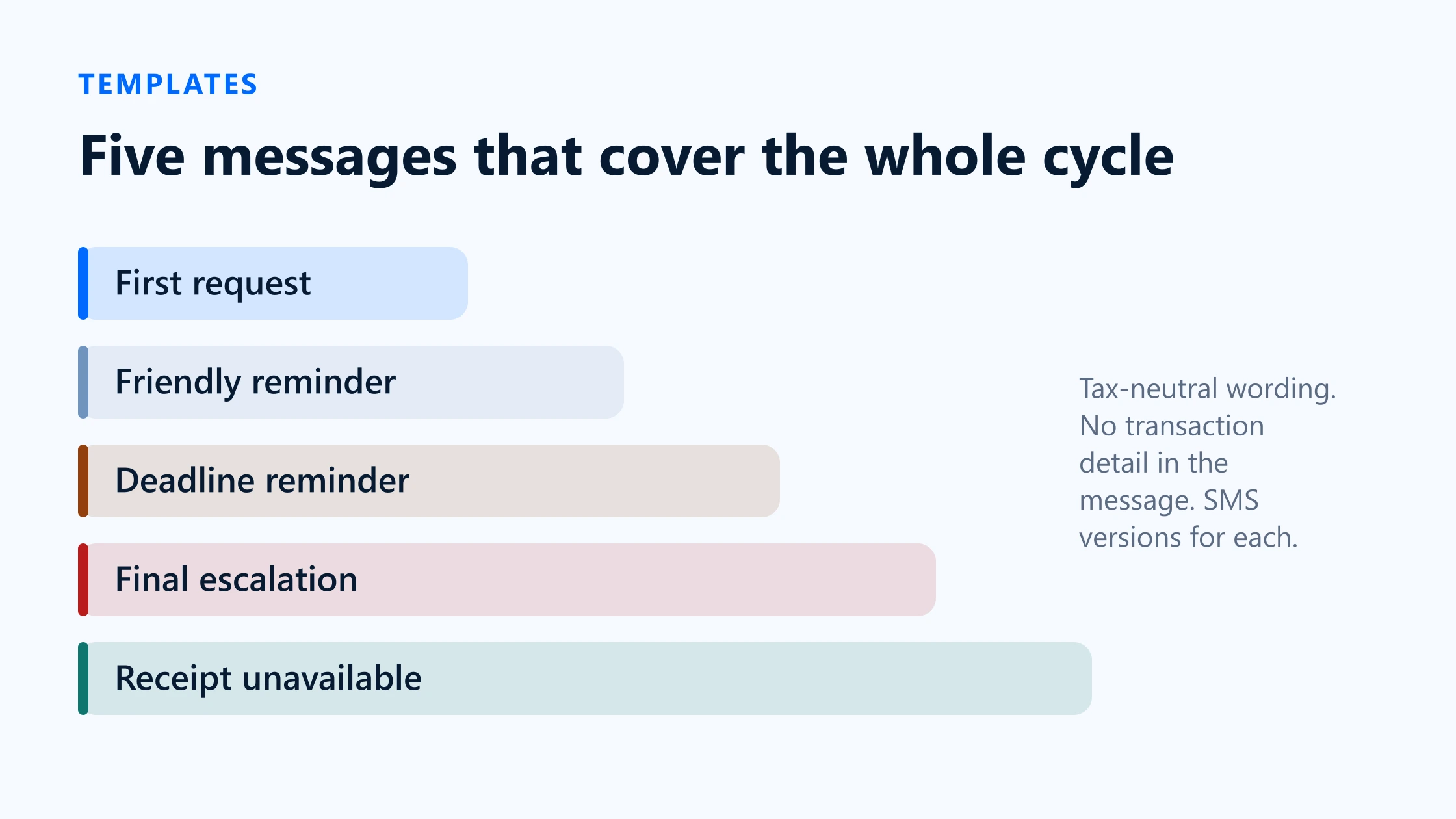
Five messages cover the whole cycle: first request, friendly reminder, deadline reminder, final escalation, and a reply for when the receipt genuinely does not exist. Each escalates in directness, and each shows the client what is still outstanding rather than repeating the original count.

Fill in the fields below and all five are generated with your firm, client, period, deadline and link, in three tones, with SMS versions underneath. The wording is deliberately tax-neutral — it says nothing about VAT, GST or sales tax — and no message contains transaction detail, because email is not a channel you can revoke.

Choose the right reminder

1. First request

When
Day 0
Tone
Neutral
What it has to achieve
Be answerable in five minutes from a phone.

2. Friendly reminder

When
Day 4–5
Tone
Light
What it has to achieve
Assume it was missed, not ignored. Show the remaining count.

3. Deadline reminder

When
2 working days before
Tone
Direct
What it has to achieve
State the consequence of missing it, factually.

4. Final escalation

When
1–2 days after
Tone
Formal
What it has to achieve
Put it on the record and offer the way out.

5. Unavailable receipt

When
Whenever the client says they cannot find it
Tone
Reassuring
What it has to achieve
Convert a dead end into a usable explanation on file.

How you refer to it to the client.

Written out, as it will appear in the message.

The transaction list stays behind this link, never in the message.

1. First request

Day 0 — as soon as the list exists

Subject: 11 receipts needed for June — about 5 minutes

Hi Sam,

We're finishing your bookkeeping for June and there are 11 payments without paperwork.

Could you send them over by Friday 28 August? Everything is on one page — no login needed, and you can photograph receipts straight from your phone:
https://your-tool.example/u/abc123

If a receipt no longer exists, mark it on the same page and tell us what the payment was for. That is usually enough for us to handle it correctly.

Thanks,
Alex, Fieldstone Accounting

SMS version

181 characters — over one SMS segment

Fieldstone Accounting: we need paperwork for 11 payments from June. One page, no login, takes about 5 minutes: https://your-tool.example/u/abc123 — please do it by Friday 28 August.

2. Friendly reminder

Day 4–5 — only if nothing has arrived

Subject: Still need 11 receipts for June

Hi Sam,

Just bumping this one up your inbox — 11 items are still outstanding for June.

The same link works, and it only shows what is still missing:
https://your-tool.example/u/abc123

The deadline is Friday 28 August. If anything on the list is a payment you can't place, send us a one-line note instead of a file and we'll take it from there.

Thanks,
Alex, Fieldstone Accounting

SMS version

155 characters

Fieldstone Accounting: 11 receipts still outstanding for June. Same link, shows only what's left: https://your-tool.example/u/abc123. Due Friday 28 August.

3. Deadline reminder

Two working days before the deadline

Subject: Closing June on Friday 28 August — 11 items outstanding

Hi Sam,

We're closing June on Friday 28 August and 11 items are still outstanding.

Anything that hasn't arrived by then will have to roll into the next period, which means it'll be harder to reconstruct and we may have to treat those payments without supporting documentation.

https://your-tool.example/u/abc123

If you'd rather talk it through than work down the list, reply and we'll call.

Thanks,
Alex, Fieldstone Accounting

SMS version

158 characters

Fieldstone Accounting: we close June on Friday 28 August. 11 items still needed — https://your-tool.example/u/abc123. Anything missing rolls into next period.

4. Final escalation

One to two days after the deadline

Subject: June closed with 11 items unsupported — action needed

Hi Sam,

The deadline for June was Friday 28 August and 11 items remain without supporting documentation. We are recording them as unsupported unless we hear otherwise.

Two ways to resolve this:

1. Send what you have: https://your-tool.example/u/abc123
2. Tell us the receipt no longer exists, and what the payment was for. There is a button for this against each item on the same page.

The second option is a perfectly normal outcome and we would rather have your explanation on file than nothing at all.

Thanks,
Alex, Fieldstone Accounting

SMS version

178 characters — over one SMS segment

Fieldstone Accounting: June is closed and 11 items have no paperwork. Send them or mark them unavailable here: https://your-tool.example/u/abc123. Either is fine — silence isn't.

5. Reply: the receipt does not exist

When a client says they cannot find it

Subject: Noted — just need one line on each

Hi Sam,

No problem at all — this happens with every client.

So the file is complete, please add a short note against each of those items saying what the payment was for and who the supplier was. One line each is enough. There is a box for it on the same page:
https://your-tool.example/u/abc123

That gives us your explanation on record, dated, which is what we need. We'll take it from there.

Thanks,
Alex, Fieldstone Accounting

SMS version

175 characters — over one SMS segment

Fieldstone Accounting: no problem about the missing receipts. Please add one line on each saying what it was for, here: https://your-tool.example/u/abc123. That's all we need.

First request

This one message determines most of your workload. A first request that can be answered on a phone in five minutes typically closes in one or two rounds; a vague one costs four or five. If you only improve one thing, improve this.

  • Put the count and the deadline in the subject line.“11 receipts needed for June — about 5 minutes” tells the client the size of the task before they open it.
  • Do not explain why you need them. They know. A paragraph of justification pushes the link below the fold.
  • Say “no login needed” explicitly. Clients have been trained by portals to expect friction, and saying it removes the reason to defer.
  • Offer the no-receipt route in the first message. Counter-intuitive, but it prevents the silence that comes from a client with nothing to send and no way to say so.
  • One link, no attachments, no second ask. Anything else competes with the thing you want them to do.

See it generated with your own details in stage 1 above.

Friendly reminder

Four or five days out, and only to clients where nothing has arrived. The single most important property of this message is that it counts correctly: a client who sent six of eleven and receives a reminder saying eleven concludes you are not reading their replies, and that conclusion is very hard to reverse.

  • Assume it was missed.“Just bumping this up your inbox” costs nothing and keeps the relationship intact.
  • Reuse the same link. A new link makes the client re-upload what they already sent.
  • Name the remaining count. A task that has visibly shrunk gets finished.
  • Repeat the alternative — a one-line note instead of a file — because the items still outstanding are often exactly the ones with no document.

Deadline reminder

Two working days before your internal cut-off. This is the first message that names a consequence, and the consequence has to be real — a deadline you do not enforce teaches the client to ignore the next one.

  • State what happens, factually. The work rolls into the next period; the payments are recorded without supporting documentation. No threats, no exclamation marks.
  • Do not apologise for chasing. By this stage an apology reads as an invitation to keep ignoring it.
  • Offer a call. For some clients the blocker is not effort but confusion about two or three specific payments, and five minutes on the phone clears the lot.
  • Consider SMS here. If email has produced nothing across two messages, the channel is the problem rather than the wording.

Final escalation and unavailable receipt

Two messages that belong together, because the escalation should always contain the exit.

  • Escalate the audience, not the volume.Copy the client’s decision-maker — the director, the practice contact who signed the engagement. One message to the right person beats four to the wrong one.
  • Record the position.“We are recording these as unsupported unless we hear otherwise” is a statement of fact and it belongs in the file.
  • Give two routes, not one. Send the document, or say it does not exist and explain the payment. A message with only one acceptable answer produces silence when that answer is impossible.
  • Make the second route sound normal.Because it is. A client who thinks “I lost the receipt” is a confession will say nothing at all.

SMS versions

SMS is the right channel for clients who do not really use email — trades, hospitality, anyone whose working day is not spent at a desk. It is a different medium and needs different copy, not a truncated email.

  • Lead with who you are. An unrecognised number asking someone to click a link is indistinguishable from a phishing attempt. The firm name goes first, every time.
  • Watch the segment boundary. A plain-text SMS is 160 characters; past that it is billed as more than one. The generator counts characters and warns you.
  • One link, nothing else.No second ask, no “reply STOP” unless your local rules require it.
  • Never put transaction detail in a text. The message will sit unencrypted in a phone that gets lent, lost and sold.
  • Do not send SMS at 7am.Working hours in the client’s own timezone, on working days.

Sources

Everything on this page that describes another company’s product, or a rule set by HMRC, comes from that organisation’s own published material. Each entry below records the date this page last checked it, because these change without notice.

Keep reading

Send these without writing them

BilagPilot runs this exact cadence automatically: consolidated per client, escalating in tone, stopping the moment a document arrives, and always showing what is still outstanding rather than the original count.

No card required. Nothing is charged automatically.